
Why Are Four-Year-Olds Being Expelled? The Pre-K Crisis
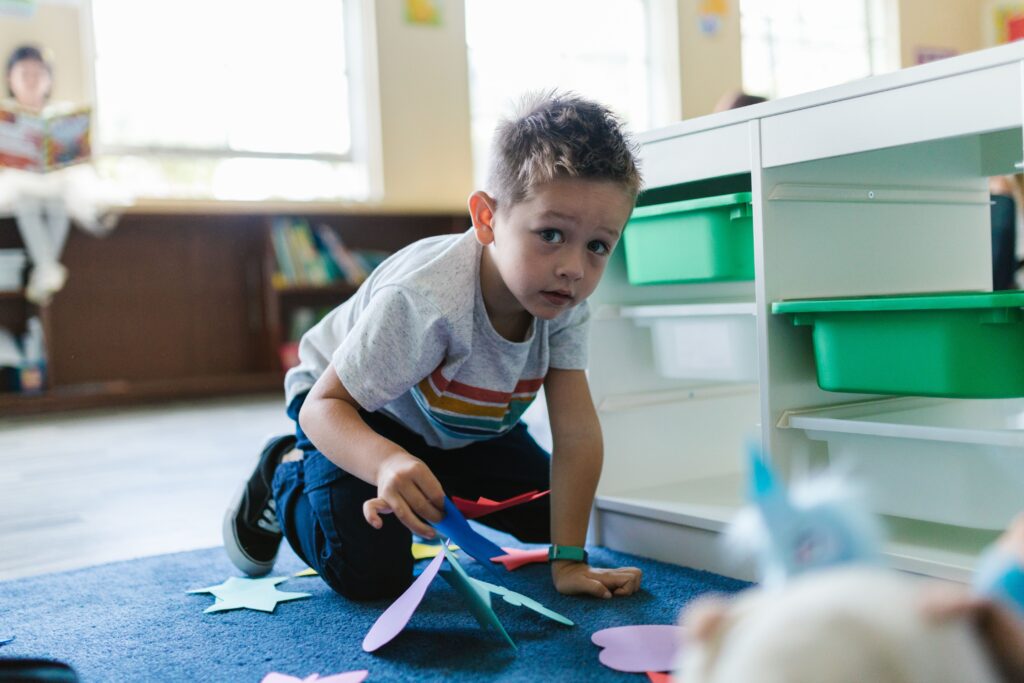
It is 9:47 on a Tuesday morning. A four-year-old has flipped a chair across the reading corner. Another is hiding under the art table and won’t come out. The teacher — who has been redirecting the same child since drop-off — is trying to keep her voice steady while seventeen other children watch to see what happens next.
By Friday, the child whose name keeps coming up may be told he isn’t coming back.
This scene is not unusual, and the outcome is not rare. Across the United States, thousands of children are being asked to leave preschool every year — many of them before they have learned to tie their shoes. The data are clear, the pattern is consistent, and the public conversation about it is almost nonexistent.
This article explains what the Pre-Kindergarten expulsion crisis actually looks like, why it cannot be reduced to individual children or individual teachers, and why a recent scoping review of the literature reframes the entire problem as something different: a missing system.
The Numbers Behind the Pre-K Expulsion Crisis
The most-cited figure in this field comes from a 2005 study by Walter Gilliam at the Yale Child Study Center. His report — Prekindergarteners Left Behind: Expulsion Rates in State Prekindergarten Programs — found that children in publicly funded Pre-Kindergarten programs are expelled at a rate three times higher than students in K-12 schools [1].
Three times higher. For four-year-olds.
Translated into bodies in classrooms, Gilliam estimated that between 5,000 and 7,000 children are removed from publicly funded Pre-K programs in the United States every single year [1]. These are not isolated incidents in a handful of struggling districts. The pattern shows up across state programs and across years.
A Quick Comparison
| Setting | Relative Expulsion Rate |
|---|---|
| Publicly funded Pre-Kindergarten | ~3× higher than K-12 |
| K through 12th grade | Baseline reference |
| Estimated annual Pre-K expulsions | 5,000–7,000 children |
Source: Gilliam (2005), as summarized in Omran’s 2026 scoping review [2].
The numbers themselves are decades old, and yet recent reviews of the literature continue to cite them — partly because the problem has not been solved, and partly because no comparable nationwide study has displaced them [2]. Federal data on discipline disparities has tracked in the same direction, including in the U.S. Department of Education’s Civil Rights Data Collection [3].
What Expulsion at Age Four Actually Means
When most people hear the word expulsion, they picture a high-school disciplinary hearing. A preschool expulsion looks different.
Sometimes it is formal — a letter, a meeting, a date by which the child must be picked up for the last time. More often, it is informal: a quiet conversation with a parent, a recommendation that the family finds a “better fit,” a slow erosion of welcome until the family simply stops coming.
The child does not always understand what has happened. The parent often does. And the next program — assuming the family can find one — receives a child who has already learned, at four, that classrooms can be places that send him away.
The downstream effects of this experience are not minor. A deep examination of long-term outcomes is beyond the scope of this piece, but the basic point is straightforward: removing a young child from a structured learning environment, without addressing the underlying behavioral need, tends to make the next environment harder, not easier.
This Is Not a Story About Bad Children or Overwhelmed Teachers
Here is where the conversation usually goes wrong.
Faced with the expulsion numbers, the public debate tends to split into two predictable camps. One blames the children — kids today, screens, parenting, diet, anything. The other blames the teachers — they need more training, more patience, more grit. Both camps are looking at the symptoms and calling them the cause.
Omran’s 2026 scoping review of the Pre-K behavioral literature pushes back on both readings directly. Its opening framing is unusually blunt for a peer-reviewed manuscript: this is not a story about bad children or overwhelmed teachers. It is a story about a missing system [2].
That reframing matters because it changes what counts as a solution. If the problem is the children, we tighten admissions criteria. If the problem is the teachers, we run another professional-development workshop. If the problem is a missing system, neither of those things will work — and the data over the past two decades suggests that neither of them has.
What Does “Missing System” Actually Mean?
The phrase sounds abstract until you put it next to what the literature actually shows.
There is no shortage of behavioral and social-emotional learning (SEL) programs designed for young children. Names like Second Step, PATHS, Conscious Discipline, and PBIS appear repeatedly in the Pre-K research base [2]. Each of these programs has real evidence behind it. Each contributes something useful — shared SEL vocabulary, scripted lessons, a different way for teachers to think about behavior, a tiered school-wide structure A6 — The Major SEL and Behavior Frameworks Used Today.
What none of them does, according to the scoping review, is put the essential operational pieces together in a single framework that holds up on an ordinary Tuesday morning when staffing is thin, training time is short, and the lead teacher is out sick [2].
The review identifies four specific structural features that, taken together, would describe what a Pre-K behavioral framework actually needs to provide — and that no current program in the published literature combines [2]:
- A tiered intervention architecture (a Multi-Tiered System of Supports, or MTSS) embedded inside an age-appropriate SEL curriculum.
- A simple, quantifiable rubric that a classroom teacher can complete in under sixty seconds.
- Somatic regulation instruction calibrated for three- to five-year-olds, whose nervous systems do not yet respond reliably to language-based strategies.
- A substitute-teacher-ready protocol that any educator — trained or untrained — can pick up and run on the first day.
This is what the missing system actually consists of. Each piece exists somewhere in the literature; no framework yet assembles all four: A20 — The Four Missing Pieces.
Why Existing Approaches Run Into the Same Wall
The clearest way to see the “missing system” problem is to look at what happens when a Pre-K classroom adopts an existing program.
A school adopts Second Step, which is built around scripted weekly lessons. The lessons are useful. But every child receives the same intervention regardless of where they are behaviorally, and the program generates no standardized data that the teacher can track over time [2]. The teacher is teaching, but cannot measure.
A second school invests in Conscious Discipline, which offers teachers a fundamentally different lens for understanding behavior. The training is meaningful when teachers stay long enough to complete it. In schools with high staff turnover, much of that investment evaporates within a year [2].
A third school adopts PBIS, the school-wide tiered behavior support model. The framework is structurally rigorous, but it was not designed to teach a four-year-old what frustration feels like in the body or what to do when their nervous system floods mid-activity [2].
Each program is doing something real. None of them, on its own, solves the daily operational problem the classroom teacher is actually facing.
Who Bears the Heaviest Weight
The expulsion numbers are not distributed evenly.
Federal data from the U.S. Department of Education’s Civil Rights Data Collection found that Black preschool children are suspended at a rate 3.6 times higher than their White peers [3]. The cause, as the literature has documented, is not a behavioral difference. It is the absence of consistent, structured support, which leaves disciplinary decisions to discretionary judgment, and discretionary judgment is not equally applied [2] A2 — The Equity Gap in Pre-K Discipline.
Teachers carry a share of the cost, too. Studies have drawn direct lines between unmanaged classroom behavioral disruption and elevated teacher stress, emotional exhaustion, and departure from the profession [4]. Early childhood settings, with their already-high turnover and limited structural support, are hit especially hard. A3 — Behavior, Burnout & Teacher Turnover.
And as of a 2014 national survey, only about 40% of Pre-K classrooms in the United States were implementing any structured social-emotional learning program at all [5]. The proportion generating measurable behavioral data from that implementation was smaller still [2] A5 — A Systems Problem, Not a Willpower Problem.
What This Reframe Changes
Once the problem is named as a missing system rather than a missing virtue, the questions shift.
It is no longer useful to ask whether teachers are doing enough, because the data suggest they are doing extraordinary work inside an unsupported structure. It is no longer useful to ask whether children are getting worse, because there is no evidence they are, and considerable evidence that consistent, structured behavioral support produces better outcomes whenever it is actually provided [2].
The more productive question is the one Omran’s review tries to answer: what specifically is missing from the published literature that, if built, would actually work in the real conditions of a Pre-K classroom? The review’s answer — the four-gap framework — is the conceptual spine of everything that comes after it.
What Comes Next
The author of the scoping review is currently developing an original framework, the Steady Minds Curriculum, designed to address all four gaps. It is in development and being piloted as part of a forthcoming action-research thesis; it is not yet a validated intervention, and the review explicitly positions it as a forthcoming response rather than an evidence-based solution [2] A26 — Introducing Steady Minds.
What is established — and what this article is built on — is the diagnosis. The crisis is real. The numbers have not improved meaningfully in two decades. The children most affected are the ones already carrying the most. And the path forward begins with refusing the easy narratives — the bad child, the burned-out teacher — and naming what is actually missing.
A system. Specifically: one that any educator can run, in any classroom, on any Tuesday, regardless of who walks through the door that morning.
Frequently Asked Questions
1. How many children are expelled from Pre-K each year in the United States?
Walter Gilliam’s 2005 study at the Yale Child Study Center estimated that between 5,000 and 7,000 children are expelled from publicly funded Pre-Kindergarten programs in the United States every year — a rate roughly three times higher than K-12 expulsion [1]. The figure remains the most-cited national estimate and is reaffirmed in Omran’s 2026 scoping review of the Pre-K behavioral literature [2].
2. Why is the Pre-K expulsion crisis described as a “missing system” rather than a discipline problem?
Because the data do not support either of the easy explanations — that the children are getting worse, or that the teachers are not trying hard enough. Omran’s 2026 scoping review argues that the field has produced strong individual components (SEL curricula, tiered behavior systems, mindfulness programs) but no single framework that integrates them in a way usable under everyday classroom conditions [2]. The shortfall is structural, not personal.
3. Do existing SEL and behavior programs solve the Pre-K expulsion problem?
Programs like Second Step, PATHS, Conscious Discipline, and PBIS each contribute meaningful pieces, and each has documented evidence behind it [2]. But the scoping review found that none of these frameworks combines the four operational features required to work reliably across diverse Pre-K classrooms: a tiered intervention architecture, an educator-operated rubric, age-appropriate somatic regulation, and substitute-ready protocols [2].
Key Takeaways
- Children in publicly funded Pre-Kindergarten programs are expelled at a rate roughly three times higher than K-12 students, with an estimated 5,000–7,000 expelled annually [1].
- These figures are not anomalies but a sustained pattern that has persisted for two decades without significant improvement [2].
- The crisis is best understood not as a failure of individual children or teachers, but as the absence of a structural support system — a “missing system” — designed for the real conditions of Pre-K classrooms [2].
- Existing SEL and behavior programs each contribute something useful, but no current framework combines the four operational features the literature identifies as essential: tiered architecture, an educator-operated rubric, age-appropriate somatic regulation, and substitute-ready protocols [2].
- The children most affected are concentrated in underserved communities, making this a structural equity issue as much as an educational one [2][3].
References
[1] Gilliam, W. S. (2005). Prekindergarteners left behind: Expulsion rates in state prekindergarten programs. Yale University Child Study Center.
[2] Omran, R. (2026). Behavioral modification and social-emotional learning frameworks in Pre-Kindergarten settings: A scoping review of the literature [Preprint, Version 1.0]. Zenodo. https://doi.org/10.5281/zenodo.20532510
[3] U.S. Department of Education, Office for Civil Rights. (2014). Civil rights data collection: Data snapshot — school discipline. U.S. Department of Education.
[4] Herman, K. C., Hickmon-Rosa, J., & Reinke, W. M. (2018). Empirically derived profiles of teacher stress, burnout, self-efficacy, and coping and associated student outcomes. Journal of Positive Behavior Interventions, 20(2), 90–100.
[5] Yoder, N. (2014). Teaching the whole child: Instructional practices that support social-emotional learning in three teacher evaluation frameworks. American Institutes for Research.
